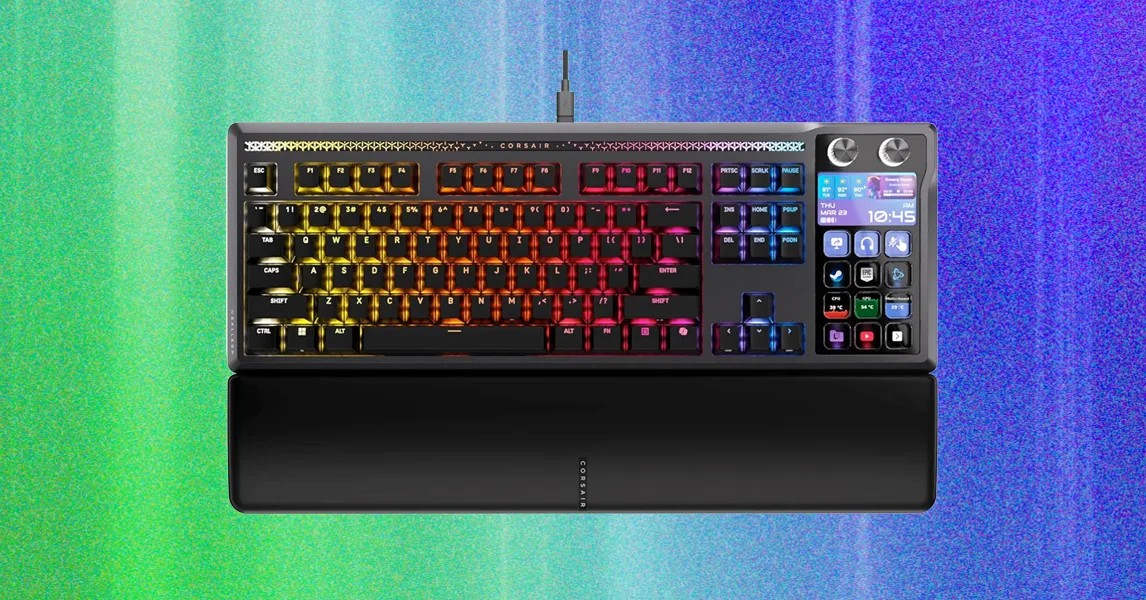
Corsair owns a lot of brands. Elgato. Scuf. Fanatec. Drop (RIP). They kept them separate. Silos. Walls. Until the Galleon 100 SD showed up.
Now they’re mixing it all together. Elgato’s macro keys. Drop’s board engineering. The result? It actually types well. Shockingly good, even. The switches are smooth. The customization is endless.
But do you need it? Probably not. The extra desk space hurts. The cost adds up. Most people want smaller boards these days. Not a footprint that takes over half the width of your desk.
Big Boat Energy
The Galleon is named after those giant Spanish ships. Fitting. It’s massive.
Compare it to a 65% board. This thing is 50% wider. That space sits between your hands. Your mouse suffers. Your left hand wanders off into the abyss. If you’re coming from a compact keyboard, the shift is jarring. For a shooter player needing every inch of mouse room, this layout is a hard no. Agility demands space. The Galleon eats it.
The size has one purpose. The integrated Stream Deck.
It replaces the number pad. Turtle Beach tried a screen on the KB7. A 4.3-inch display. But it lacks tactile buttons. You can’t feel the Galleon’s macros. That’s the difference. If you need buttons. Physical clicks. This does it.
But again. Mouse space. For Quake. For fast FPS titles. The trade-off feels heavy.
When the keyboard itself performs though? It’s impressive. 8,000 Hz polling rate. Insane speed. Inputs register faster than the eye can blink. I felt it in Marvel Rivals. Snappy. Precise. Star Wars: Battlefront 2 benefits too (yes, that game is having a weird resurgence thanks to private servers).
Will 8K Hz save your aim? Maybe not. Halo 3 players don’t care. But the SOCD cleaning? That’s where the magic lives.
Simultaneous Opposing Cardinal Directions. You hold left. Press right. You don’t stand still. You move right. The last key wins. It creates fluid, ultra-fast strafing. Some competitive scenes ban it. Counter-Strike 2 lobbies will kick you for using it. But for everything else? It makes movement effortless.
Here’s the catch. The switches aren’t Hall Effect. No Rapid Trigger. No adjustable actuation points. Just standard mechanical stems.
You can hot-swap them. MX-style sockets under every key. Fine-tune the feel? Yes. Get pro-level trigger resets? No.
This isn’t a pure racing keyboard. It’s a hybrid. Performance meets tinkering.
Gasket Mounted and Strange
Typing on this board is… soft.
Corsair used a gasket mount assembly. The internals hang in rubber gaskets. Not screws. No hard plastic clatter. It feels like typing on a trampoline. Bouncy. Quiet.
There’s a hidden benefit to the split design. The PCB for the letters is separate from the Stream Deck module. The rigidity stays consistent under your fingertips. It feels like a solid Tenkeyless board when you type.
The stabilizers are surprising. Usually plate-mount stabilizers rattle like a tin can. Corsair put them on the PCB. They’re pre-tuned. Clean.
Then you get to the Stream Deck buttons.
Identical to the standalone units. Three columns. Four rows. Two knobs. A screen. Program them how you want. Helldivers 2 Stratagems show their icons right there. CS:GO buy menus. Alt+Tab. Mute. Useful? Absolutely.
But the implementation is flawed.
The buttons assume you’re looking down at them directly. The Galleon lays flat. The viewing angle is bad. Text at the top or bottom gets cut off by the housing. You literally cannot see half the label while you use it.
The feel is mushy too. A rubber ring under the keys creates a weird, inconsistent press. The computer knows you clicked it. Your finger feels like it’s sinking into wet sand.
Worse. The lag.
Input delay on the Stream Deck is real. Especially during fast typing. The delayed macro fire will interrupt your sentences. Letters insert themselves where they don’t belong. It reminds you of the truth. This isn’t one device. It’s two different systems duct-taped together.
Frankenstein isn’t a compliment in tech reviews.
Is It Worth the Repairs?
I worried about support. Corsair’s software can be iffy.
But since this uses standard Stream Deck hardware under the hood, updates should trickle down. Maybe. I’ve been burned by iCue before. There could be proprietary locks hidden in the firmware. We’ll see.
Repairability? Don’t bother.
Open it up. You’ll find a mess of metal tabs and screws holding the Stream Deck section tight. It’s not designed for user access. I took it apart. Complicated. Fragile. If that module dies, you replace the whole keyboard. No modularity here.
So, should you buy it?
The Galleon works. Typing is good. Macros work. It’s bug-free, mostly. But the downsides of the large layout outweigh the novelty.
You can buy a $150 custom board. Then a $150 Elgato Stream Deck. Separate pieces. You place the Stream Deck where you want it. You replace it if it breaks. You keep the board.
The integrated version offers convenience. Convenience often comes with hidden costs. In flexibility. In space. In money.
Think about that desk setup. Is the extra button row really worth the chaos?
Maybe. Or maybe not. That’s up to you. And your desk.