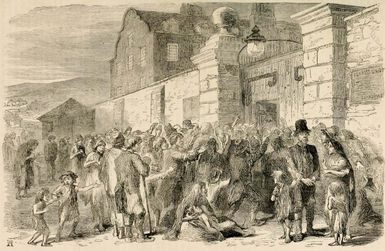
Pictures of workhouses during the Irish Potato Famine (1845-1849) are a stark reminder of what relief used to be like. This is more than just help. This is punishment disguised as charity.
In the 19th century, public assistance to the economically poor was a chaotic regional situation. When droughts, wars and crop failures occur, communities are thrown into chaos. A local committee was established. They distributed food, clothes and medical supplies. They built a temporary shelter. Money and supplies poured in from other cities and countries, but everything was chaotic.
Then came the 20th century. The International Red Cross was founded in the 1860s to help victims of war and is the focal point of international humanitarian aid. Rescue operations were organized. More institutionalized.
But what is the philosophy behind it? This has been strict for centuries.
Shame on able-bodied people
Public programs to help people in financial need date back to Elizabethan England. The early laws were strict. Their goal is not only to alleviate suffering, but also to control costs.
Helping able-bodied workers is almost morally repugnant. Our beliefs are simple. “If you can work, you should work.” It is good to help the “deserving poor”. Giving it to “lazy people” was seen as encouraging bad habits.
In Britain this situation culminated in the Poor Law Reform Act of 1834. This setup is brutal.
Healthy people can only get well-being if they are taken into a workhouse.
Life in these facilities is designed to be worse than minimum wage work outside. This is a deterrent. A way of saying, “We’ll help you, but only if you give up your dignity and your job.”
American labor assistance model
This idea has not disappeared. It has evolved.
In the United States, the Great Depression forced a rethink. However, the basic idea remains the same. Labor must be exchanged for help.
The Work Progress Administration (WPA), later renamed the Work Project Administration (WPA), became a prime example in the 1930s. This is a huge work assistance program. Governments do more than just write checks. They built roads. It painted murals. It rewards writers.
The goal is clear. Let’s make a distinction between people who can do their job and people who can’t. This is a way to maintain self-respect and maintain social order. You are not a beggar. You are a worker stuck in hard times.
Shift Away from Mandatory Labor
By the end of the 20th century, the demands for social welfare work began to decline in most developed countries.
Why?
——The economic structure changes. Manufacturing has moved.
– Society’s understanding of poverty has changed.
– The shame of the workhouse was too expensive both politically and morally.
Today, disaster relief and financial aid look different.
Modern public assistance usually refers to benefits provided to individuals who are not eligible for certain insurance programs. This includes unemployment insurance, food assistance and direct cash transfers. The focus shifted from forced labor to balancing basic needs.
In modern terminology, a distinction is made between “aid” (emergency aid) and “social welfare”
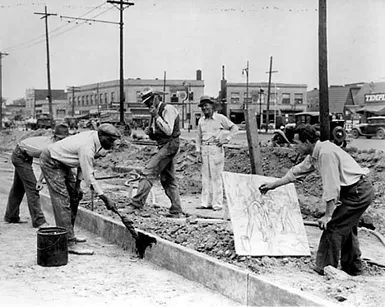
Cameras weren’t always the primary lens through which America captured the Great Depression. Sometimes it’s a charcoal stick. In 1939, Michigan artist Alfred Castagne stood amidst the dust and noise of a Works Progress Administration (WPA) construction site. He wasn’t painting a pretty picture of the government’s success. He draws workers.
These aren’t just idle figures. They are the backbone of a large-scale federal experiment.
WPA Labor Realities
The WPA employed millions of people. At its peak, nearly a quarter of unemployed Americans had a job. Castagne’s sketches from that site in Michigan provide a ground-level perspective on this reality.
You can see the fatigue in the lines. Although heavy machinery looms in the background, the focus is still on the human element. The workers aren’t posing. They’re are working. This distinction is important.
“It’s about the dignity in labor, not just the product.”
The WPA did more than just build roads. They built bridges, parks and public buildings. It also funded artists. This dual approach is unique. The government recognizes that mental health is closely related to economic stability.
Why sketches are more important than photos
Photography became iconic during the Great Depression. Dorothea Lange’s “Migrant Mother” is a classic example. But the sketches offer something different. They capture movement. They capture the purpose.
Castagne’s work emphasizes the physical strain of construction. The lines are rough. The figures are solid. There’s no glamour. This is a living record of the plight of the American working class during the crisis.
Choosing to record laborers specifically instead of politicians or finished structures make-work the story. It gives value to the worker and not to the organization.
Broader Economic Impact
The WPA spent nearly $11 billion. That’s billions in 1939 dollars. Today it is about $200 billion. The impact was immediate.
- Employment: Reduced unemployment rates significantly.
- Infrastructure: Thousands of public projects were built or improved.
- Cultural Legacy: Funded tens of thousands of artists, writers and musicians.
Castagne’s sketches are only part of a larger story. They show the human cost and the human effort.
Looking Back at the Trade-offs
Critics argue that WPA is inefficient. Some projects have been criticized as “make-work”. But the alternative is widespread poverty. The trade-off was clear.
The government has decided to pay people to create. It chose to invest in public goods. The cultural output, including art like Castagne’s, are a lasting dividend of this decision.
These sketches remind us that policy is about more than just numbers. It’s the people. hands dirty with concrete. It is the quiet dignity of doing work.
that image remains relevant when discussing federal spending and job programs. Who gets to work? What types of work are counted? WPA answers these questions with a bold experiment. Castagne recorded the answer.