The first Steam Machine was a joke. A confused pile of OEM partners trying to sell you a PC for your TV that barely worked. A decade later, Valve tried again. This time? One manufacturer. One design. Clean lines. It looked promising. Really promising.
So why does it feel like a missed turn?
Because it is tantalizingly close. And just as frustrating. It sits on that razor’s edge between greatness and mediocrity.
Looks Like a Brick
The device itself is adorable. Literally.
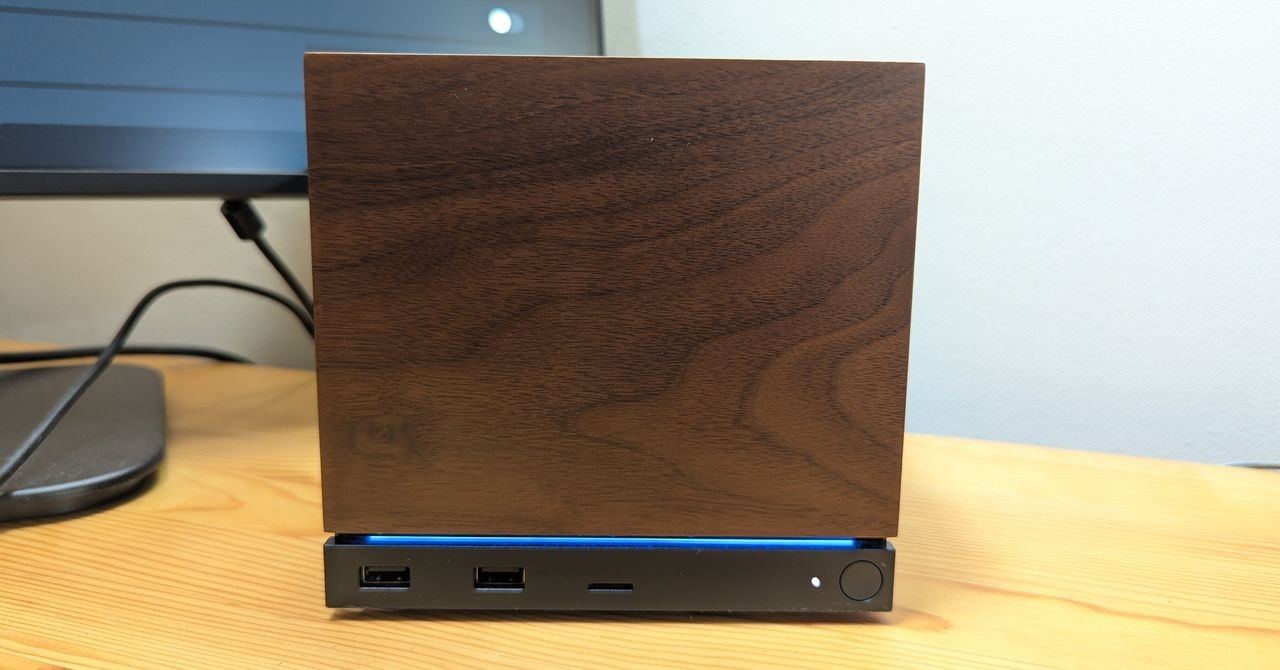
It is roughly the size of a GameCube. 156 mm by 152 mm by 162 mm. It tucks into entertainment centers with the ease of a well-behaved pet. There is a LED light bar underneath that smiles at you. Or mocks you. It serves as an installation progress bar by default, which is a nice touch.
Faceplates are swappable. Only on the 2 TB model though. One wood. One red fabric. They scream “1970s apocalyptic science facility” in the best possible way. Peel them back and you see the truth. A densely packed PC chassis fighting a war against heat. An enormous exhaust fan dominates the rear, ready to blow your DVDs across the room.
Connections? Decent.
- Two USB-A 3.2 ports in the front
- One microSD slot
- Rear has two USB 2.0 ports, one USB-C 3.2, HDMI 2.0, and DisplayPort 1.4
- Gigabit Ethernet. Wi-Fi 6E. Bluetooth 5.3
It weighs 5.7 pounds. No external brick. That matters. You can actually move it from the bedroom to the living room without wrestling a power adapter. Setup is plug-and-play. Mostly. Just sit through a 15-minute system update first.
You need a controller. The Steam Controller works here, but it isn’t included unless you pay extra. Unforgivable. It connects via USB cable and pairs directly, bypassing its wireless puck. It can even wake the machine from sleep.
SteamOS boots up in Big Picture mode. Familiar territory. Clean tiles. Clear categories. Cloud saves let you jump right in. But check Desktop mode if you’re feeling brave. It runs KDE Plasma. It is a full Linux PC. Mouse and keyboard work instantly.
The interface is sterile. Clean. Icons for Settings, the software store (Discover), file manager, Firefox. That’s it. It is surprisingly welcoming. I wrote half this review on it. LibreOffice installed from Discover in seconds. Far from gaming, this thing might just demystify Linux for everyone as Windows 10 support winds down.
Specs vs. Reality
Nobody buys this to balance a spreadsheet. Let’s talk gaming.
The specs are roughly on par with the PS5. Released nearly six years ago. The CPU wins. AMD Zen 4, six cores, up to 4.8 GHz. The PS5 is stuck on older Zen 2.
The GPU? A loss. RDNA 3, 28 Compute Units. The PS5 has 36 (though it uses older RDNA 2). The weakest link? 16 GB of DDR5 system RAM sharing space with only 8 GB of GDDR5 VRAM. Upgradable, sure. But opening that box feels like defusing a bomb.
Valve claims “up to 4K at 160 Hz.” Up to. In theory. With AMD’s FSR upscaling tech doing heavy lifting. The official “Verified” benchmark for Steam Machine games is 1080p. There’s a gap there.
I tested four games on a 4K OLED and a 108p monitor. Both at 120Hz.
Spider-Man Remastered worked well. Default output hit 2048×1152 at smooth 60 fps. I forced native 4K. Frame rate tanked to 30-45. I turned on FSR with Dynamic Resolution Scaling targeting 60. It held 60 in 4K. HDR colors popped. On the 108p desktop monitor, it ran a locked 60 easily. No HDR support on that screen though, so everything looked washed out. Best performance of the test.
Crimson Desert? Officially unsupported. Boots anyway.
On Ultra settings with FSR set to Native Anti-Aliasing, the menu hit 40 fps. In-game? 20 to 25. Juddery. Lowered graphics to High. 25 to 30. Screen tearing in cutscenes. Cut upscaling resolution to “Balanced” and it brushed against 60. Image quality suffered badly. Foliage and water looked like smears of paint.
On the 108p monitor, Ultra settings + Ray Tracing ran a solid 60 fps. Still… not ideal. But acceptable. For a game Valve says won’t run?
Lego Batman: Legends of the Dark Knight was a disaster. 4K with FSR and High graphics? Frame rates swung wildly from 15 to 45. Push FSR to Performance. Got 45 reliably. Sometimes spiking to 90. But vehicle sections dropped below 30.
Switch to 108p. Settings on High. Upscaling to “Ultra Performance.” Finally a sweet 60. Try to improve image quality? Drop back to 30. The problem wasn’t the Steam Machine. I saw identical performance on an MSI Claw 8 handheld. This game is just poorly optimized for PC. Period.
Granblue Fantasy Relink was bizarre. Menu hit 120 fps on the 4K TV. Gameplay? 30 to 44. Cinematics? 30s. Static dialogue scenes? Dropped to 15 fps for no reason. The game has no internal frame gen options. Lowering presets didn’t help. On the 108 monitor, the OS still thought it was pushing 4K signals until I manually forced 1920×1080. Then? Solid 60 fps.
A Compromised Box
Here is the truth. The Steam Machine cannot deliver a consistent 4K 120Hz experience.
It can, with effort. If you dive through every menu, tweak every slider, and sacrifice image fidelity. It is a massive hassle. For what? A worse experience than a dedicated console offers out of the box? For a price that tops the PS5 Pro?
It feels like a rushed product. The hardware Valve had available in the AI-chip-hungry market of 2026, not the machine they designed on paper. More RAM would help. A faster GPU would help. But supply chains dictate reality.
If you only play indie games? Fine.
If you play AAA titles? You’re slumming. You will be forcing sub-4K resolutions onto a 4K TV just to get playable framerates.
Is it better than docking a Steam Deck to your TV? Absolutely. Is it the future of console gaming?
Maybe not yet. When it comes to raw, unoptimized AAA performance, the PS5, the Series X, or the upcoming Switch 2 still punch harder. This machine walks a line it shouldn’t have to.
It leaves you waiting. Waiting for a patch. A hardware refresh. A better day.