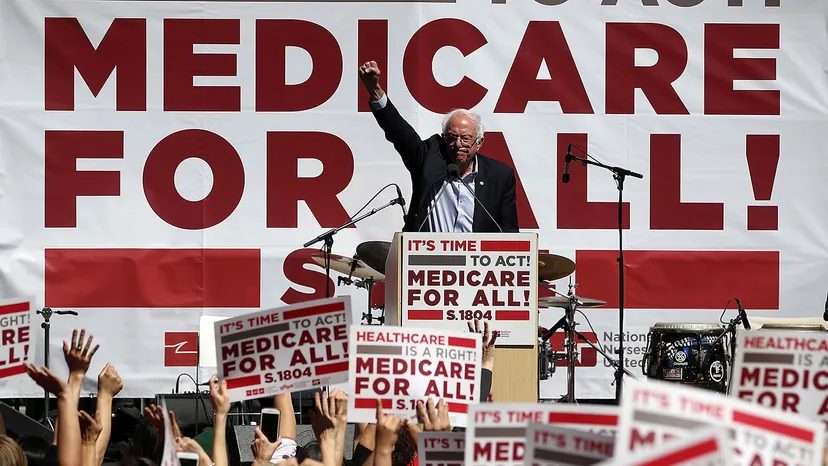
Bernie Sanders didn’t invent the phrase. But in 2016, as a presidential candidate, he was the first to drag “Medicare for All” out of the fringe and into the national spotlight. The idea was simple on paper: expand the government-funded safety net for seniors to cover every American. The reaction was binary. Progressives cheered. Republicans called it a socialist nightmare. Mainstream Democrats sat on the fence, wary of the price tag.
Fast forward to the 2020 election cycle. The candidate field shrank from 20 to 11. The rhetoric didn’t. But something shifted. Support for a “national health plan” hit 56 percent in a January Kaiser Family Foundation poll. That number has been stagnant since June 2017. Even 24 percent of Republicans now back the concept. Sanders is still in the race, he’s 78 years old, and he’s no longer the only voice in the room.
Enter Pramila Jayapal.
In February 2019, the Washington Democrat and her progressive allies dropped the Medicare for All Act of 2019. It’s not just a rehash of Sanders’ 2017 bill. It’s an escalation. If you are searching for how this new proposal differs from previous iterations, the answer lies in its ruthlessness. Jayapal’s plan doesn’t just expand coverage. It demands the total elimination of private health insurance.
The Jayapal Plan: No Premiums, No Private Insurance
The current system is a patchwork. You have employer-sponsored plans, ACA marketplace plans, Medicaid, and Medicare. Jayapal wants to burn the patchwork.
Her bill mandates a single-payer system with three non-negotiable pillars:
- Universal Coverage from Birth to Centenarian. Age is no longer a threshold. Newborns get the same card as the elderly.
- Ban on Private Competitors. Private insurers are barred from offering plans that compete with the national program. This isn’t a tweak to the market. It’s an eviction notice for the $1.2 trillion private health insurance industry.
- Zero Out-of-Pocket Costs. No premiums. No deductibles. No co-pays. No co-insurance. You show your red-white-and-blue card. You get treated. Period.
“It’s time for Medicare for All.” — Rep. Pramila Jayapal
The scope is broader than most realize. Under Jayapal’s framework, Medicare expands to include comprehensive dental, vision, hearing, and long-term care. That last one is huge. Nursing home stays, previously a financial cliff for many families, become a covered service.
Karen Pollitz, a health policy expert at the Kaiser Family Foundation, notes the simplicity of the proposed model. You get the card. You get taken care of. It covers everything currently in private insurance, plus the extras. It’s comprehensive. It’s all-encompassing. And yes, it would put a lot of policy briefs out of business.
What Medicare for All Is Not
Confusion persists. Critics often conflate “Medicare for All” with “socialized medicine.” They point to the United Kingdom’s National Health Service (NHS). In the UK, the government is the insurer. It also owns most hospitals and employs most doctors. It’s a vertical monopoly.
Jayapal’s plan is not that. It’s closer to Canada’s system, often just called “Medicare.”
In Canada, doctors and hospitals remain private businesses. They compete for patients. But they don’t compete for insurance. They bill a single public payer. All reimbursements flow through the government system. The profit motive exists in the delivery of care, not in the financing of it.
There is a catch, though. Canada’s version doesn’t cover everything. Dental, vision, prescription drugs, and long-term care are largely excluded from the public umbrella. Citizens often rely on private insurance for those specifics.
Jayapal’s proposal closes that gap. It forces the public system to cover what Canada leaves to the private sector. That’s the fundamental trade-off. You lose the private insurance industry. You gain total financial protection against medical costs. But the cost of that protection? That’s where the numbers get complicated.
The Financial Reality
The current system costs Americans trillions. Private insurance administration alone adds billions in overhead. Billing codes. Network negotiations. Marketing. Profits.
A single-payer system cuts that fat. But it doesn’t eliminate the cost. It just moves it.
The question isn’t whether the care is free at the point of service. It’s who pays for it beforehand. Taxes would rise. Significantly. The savings from eliminating private insurance premiums and administrative bloat would offset some of that burden. But the net effect? That depends on how you structure the tax code.
Sanders’ earlier bills proposed financing through increased taxes on the wealthy and corporations. Jayapal’s legislation is similar in intent but distinct in its absolute ban on private competition.
Is it worth it?
For those facing medical bankruptcy, the answer leans yes. For those with robust employer-sponsored coverage that they like, the answer leans no. They lose choice. They lose the specific network they’re used to. They pay more in taxes.
The political math is tricky. 56 percent support is a majority. But a majority doesn’t pass legislation. A supermajority does. And the 2020 field is crowded. Not everyone in it is ready to dismantle the insurance industry.
Jayapal’s bill is a statement. It’s a north star. Whether it becomes law is another story. The hearings have started. The debate has moved from “if” to “how.” And the “how” is expensive.
The Tax Price of Universal Coverage
The mechanics of a single-payer system are straightforward in theory but brutal in practice. The federal government becomes the sole insurer. To fund that monopoly, it needs cash. Lots of it.
Currently, the government covers roughly half the nation’s health care bill through existing programs. But a total shift to Medicare for All requires replacing the private premiums, deductibles, and co-pays that individuals and employers currently pay. That gap doesn’t close itself. It gets filled with new taxes.
The scale is difficult to visualize until you look at the ledger. In 2018, Medicare alone consumed $605 billion of the $4.1 trillion federal budget. That’s 15 percent of every dollar the government took in. The proposed Sanders bill from 2017 estimated a staggering $32 trillion cost over ten years. This figure excludes long-term care, which would only inflate the total further.
Experts like Pollitz note the sheer magnitude of the transition. “That’s a lot of money,” she says. The revenue mechanism would likely involve hiked income taxes, payroll taxes, corporate levies, and excise duties. It is a fundamental restructuring of how the country funds its health.
Will Support Crumble Under Higher Taxes?
Public opinion on Medicare for All is fragile when confronted with the bill. When Americans realize their income taxes would likely rise to cover the switch, support for the national health care scheme drops by 23 percent. The fear of higher taxes is a powerful deterrent, even for those who dislike their current insurance.
Critics seize on the $32 trillion figure to argue the plan is unaffordable. The numbers are indeed high. But they are also misleading if viewed in isolation.
Consider the current baseline. American households and the government combined are spending $3.5 trillion annually on health care. That is more than any other country on the planet. If you project that current spending over a decade, you get $35 trillion.
“If you multiply that out by 10 years, it’s $35 trillion, even greater than the cost of Sanders’ Medicare for All proposal.”
Under a single-payer model, Americans would pay zero premiums. Zero deductibles. Zero co-pays. The money would still leave their pockets, but it would go to the IRS instead of insurance companies and pharmacy benefit managers. In this calculation, switching systems could actually save the country money overall, provided administrative waste is eliminated.
Disruption in the Medical Industry
A transition of this size would be chaotic. The most obvious casualty would be private insurers. With no need to manage risk or market plans, most would fold.
Pharmaceutical companies would face a different kind of pressure. Drug prices would likely be capped, slashing profit margins that have driven industry growth for decades.
Then there are the doctors and hospitals. Medicare typically reimburses providers at lower rates than private insurers do. This creates a clear hierarchy of winners and losers.
“The key question is what will those payment rates be for doctors and hospitals. The Jayapal bill doesn’t really say. That’s still a key question to be addressed and debated.”
Pollitz points out that many doctors already refuse Medicare patients because the reimbursement rates are too low and the paperwork is excessive. If the new system doesn’t significantly raise those rates, quality care could suffer. However, there is no evidence to suggest that a single-payer system inherently leads to long wait times for life-saving procedures or fewer covered treatments. In fact, the Jayapal proposal aims to expand coverage.
Some argue that seniors don’t wait in line for prescriptions or appointments under current Medicare. The system is quick and relatively easy for those already enrolled. The challenge is scaling that efficiency to the entire population without bankrupting providers.
Opt-Outs and Alternative Paths
The Medicare for All Act of 2019 does offer an escape hatch. Doctors and patients can opt out of the single-payer system entirely. They can choose to pay in cash for services, bypassing the government plan altogether. This preserves a market for those who can afford it and want to avoid the bureaucracy.
But is Medicare for All the only path forward? No.
Other proposals in Congress aim for less disruption. Some suggest keeping the current private system but adding a public option based on Medicare. Others propose allowing older adults not yet eligible for Medicare to buy into the system.
Public sentiment seems to favor these middle-ground approaches. A January 2020 poll showed that two-thirds of Americans favored adding a public option. Only 56 percent supported the full Medicare for All model.
The debate isn’t just about cost. It’s about how much chaos the country is willing to endure for the promise of universal coverage. The numbers suggest a single-payer system might be cheaper in the long run. But the political and economic shock of dismantling the current insurance industry remains a massive hurdle.